Education only
Foraging basics, taught carefully
If you are not certain, do not eat it
Some edible plants have deadly look-alikes. Learn from an experienced local forager, a botanist, or a university extension program before harvesting anything — especially mushrooms.
Identification basics
Dandelion
Key marks: Toothed basal leaves, hollow unbranched stem, single yellow flower head, milky sap.
Watch out: Cat's ear and hawkweed have hairy, branched stems.
Blackberry
Key marks: Arching thorny canes, palmate leaves of 3–5 leaflets, clustered drupelets.
Watch out: No toxic look-alike in most regions, but confirm thorn and leaf pattern.
Wild garlic / ramps
Key marks: Strong garlic scent when crushed, smooth parallel-veined leaves, single bulb.
Watch out: Lily of the valley and false hellebore are poisonous and have no garlic scent.
Broadleaf plantain
Key marks: Oval ribbed leaves in a rosette, thin seed spike, no milky sap.
Watch out: Confirm the parallel ribs running the full leaf length.
Elderberry
Key marks: Opposite compound leaves, flat-topped flower clusters, small dark purple berries.
Watch out: Pokeweed has a single thick stem and toxic berries in a hanging cluster.
Chanterelle
Key marks: False gills that fork and run down the stem, fruity scent, solid flesh.
Watch out: Jack-o'-lantern mushroom has true blade gills and grows in clumps on wood.
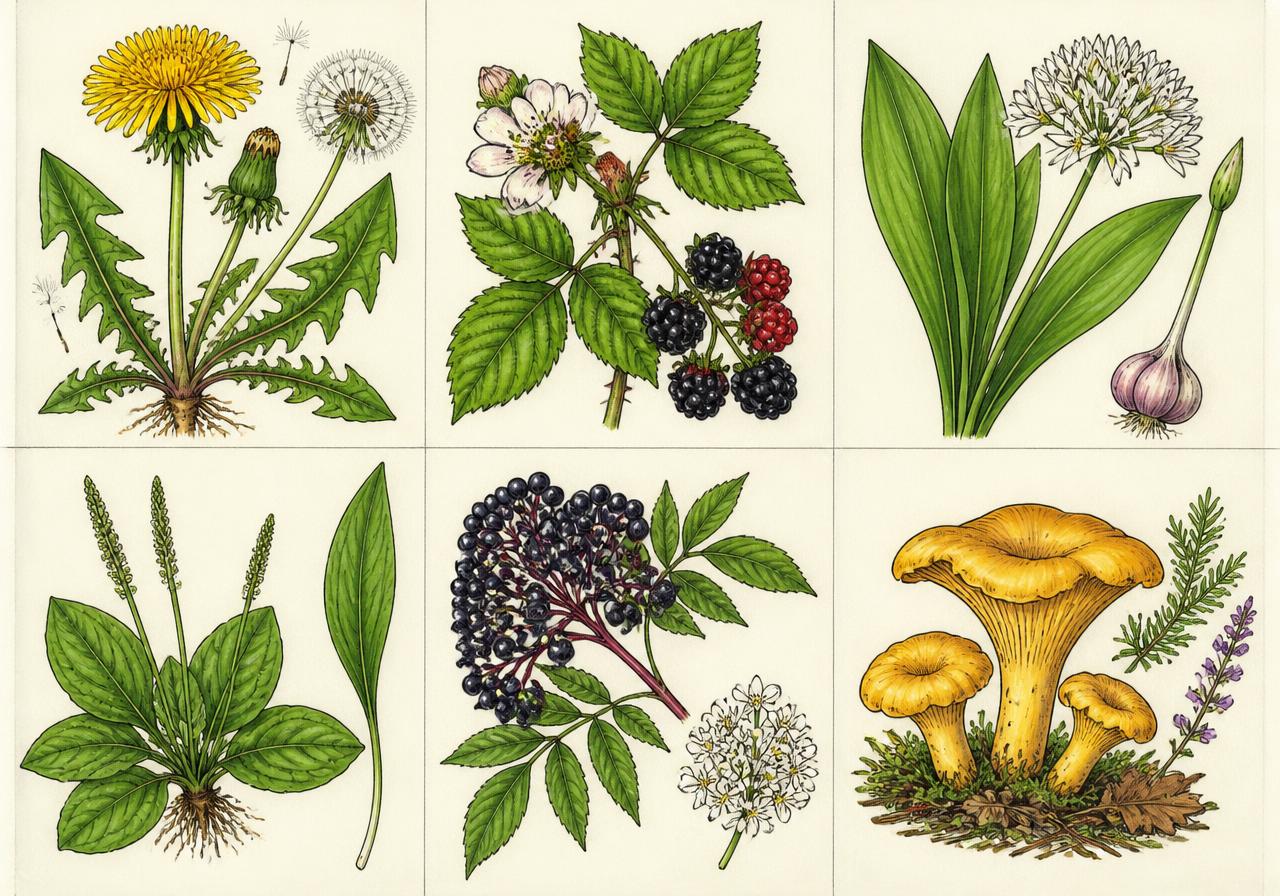
Study drawings alongside live plants in every season — leaves, flowers, and seed heads all matter.
Safety rules we teach
- Never eat a plant you cannot identify with total certainty from at least two reliable sources.
- Learn the poisonous look-alikes for a species before you ever learn the edible one.
- Fungi require in-person mentorship. Photos and apps are not identification.
- Skip roadsides, sprayed lawns, industrial sites, and runoff areas.
- Harvest a small amount, take only from healthy stands, and leave roots and habitat intact.
- Introduce any new wild food in a tiny portion, once, and wait a day.
- Foraging with children means identification, not tasting.